Flock

It’s been a hard month for license plate readers in Washington State

Seattle News:

Katie Wilson will be Seattle’s next mayor, and Seattle’s 2026 budget has been adopted! Whew, what a month. 

I wrote my take on the budget last week, a few days before its final passage. You can also read a list of budget amendments proposed by the councilmembers and PubliCola’s budget wrap-up

No budget discussion would be complete without noting both the efforts on the parts of councilmembers to limit the Mayor-elect’s budget flexibility. There are also deep concerns over the likely loss of federal funding for housing and homelessness programs via the Continuum of Care funds from HUD, especially permanent supportive housing funding. 

A coalition of states, including Washington, has filed a lawsuit against HUD over the above policy changes.

King County has selected Connections Health Solutions to run the new crisis care center in Capitol Hill. Connections already runs the crisis care center in Kirkland and is a national company as opposed to a local community based provider. 

DivestSPD published some charts last week about changes at the Office of Police Accountability (OPA). According to Divest, the OPA only fully investigated 23% of complaints in 2025 compared to 37% in 2023, when the department was under the leadership of former Director Gino Betts. 

OPA contact logs have also increased from 16% in 2022 to 28% in 2025, so it will be interesting to hear from the OPA next year (now under the leadership of Bonnie Glenn) as to why this is the case. 

For those interested in the Families, Education, Preschool, and Promise (FEPP) levy spending plan, the Department of Education and Early Learning (DEEL) is holding four community outreach/conversation sessions in December, for which you can RSVP:

  • Tuesday, December 2, 5:30–7:30 PM at the Magnuson Community Center, 7110 62nd Ave NE, Seattle, WA 98115 
  • Wednesday, December 10, 5:30–7:30 PM at the Ballard Branch – Seattle Public Library, 5614 22nd Ave NW, Seattle, WA 98107 
  • Thursday, December 11, 5:30–7:30 PM at Denny International Middle School, 2601 SW Kenyon St, Seattle, WA 98106 
  • Tuesday, December 16, 5:30–7:30 PM at Rainier Community Center, 4600 38th Ave. S, Seattle, WA 98118 

Divest SPD reported that less than 10% of 2025 SPD recruits were women, a blow to the department’s 30×30 initiative. 

Skeptics of the initiative point out that women making up 30% of the police force wouldn’t necessarily fix the systemic issue of police violence. Also concerning is the department’s efforts to recruit women without a clear plan in place to address what appears, from both lawsuits and conditions documented in a 30×30 report published in September 2023, to be a hostile workplace for women. 

New Councilmember Eddie Lin was sworn in today. Councilmember-elect Dionne Foster and Mayor-elect Katie Wilson won’t be sworn in until the beginning of 2026, but because Lin’s seat was being held by an appointee, he was sworn in early. 

For the same reason, King County Executive Girmay Zahilay was sworn in today. 

Surveillance News:

I wrote about Washington cities’ struggle with what to do about Flock Safety license plate readers (ALPRs), both because of the evidence that the data is being shared with federal agencies, including ICE, and because of a recent lawsuit brought by the cities of Stanwood and Sedro-Wooley in which ALPR video was deemed to be within valid public record parameters. As a result, many Washington cities have paused or delayed their ALPR programs. 

In the summer, I reported that it looked like the King County Housing Authority’s (KCHA) ALPR camera data had been shared with federal agencies such as ICE. KCHA has since decided to end their ALPR pilot. 

Since I wrote the article, Stanwood and Sedro-Wooley have appealed the court decision about whether ALPR video counts as a public record, and residents of Olympia are asking their city council to shut down their Flock ALPR program.

There are also new records showing that ALPR programs are being used to surveil protesters and activists, including in Washington state. 

Meanwhile,The Intercept found that fusion centers were being used to surveil pro-Palestine protests on at least five college campuses across the country. Fusion centers were established after 9/11 to better enable information sharing between federal, state, and local law enforcement agencies, including campus police. 

“The normalization of intelligence sharing between campus police departments and federal law enforcement agencies is widespread across U.S. universities,” the Intercept wrote.

Washington State News:

Governor Bob Ferguson made an appointment to fill the upcoming vacancy on the Washington Supreme Court: Colleen Melody, who spent the last decade working at the Attorney General’s office leading the civil rights division (a position to which she was hired by Ferguson). While at the AG’s office, Melody was deeply involved in filing lawsuits against President Donald Trump’s executive orders during his first term from 2017-2020. A career government lawyer, Melody has never before served as a judge. 

Melody will serve as a Supreme Court justice for 2026, but she would have to run for election next November in order to retain the judgeship. The big question to consider, should she choose to run, is her stance on the legality of a wealth tax in Washington state. 

The latest state revenue forecast showed a slight uptick in revenue projections for the current biennial budget (2025-2027), but not enough to make much difference. Talk abounds about potential new revenue sources for the state. It’s unclear if we’ll see a repeat to this year’s legislative session when Ferguson said he’d veto any budget proposal that included a wealth tax. 

Ferguson is expected to release his budget proposal before the end of the year, giving us a few weeks to review it before the next state legislative session begins on January 12. 

Recent Headlines:

It’s been a hard month for license plate readers in Washington State Read More »

City Council begins budget gymnastics as alternative response in Seattle takes another blow from the new SPOG contract

My Recent Stories:

First up, we have my Urbanist story documenting the saga of King County’s pre-filing youth diversion program Restorative Community Pathways, which King County Executive Shannon Braddock is planning to replace with a new program. I’ve been following this story for some months and was just waiting for the Impact Justice evaluation to be released before writing it up. However, it turned out to be so complex that I think this is the longest story to date I’ve published at The Urbanist. I haven’t seen this covered in this depth at any other outlet thus far, and I hope you’ll take the time to have a read. 

Last week the new SPOG contract was announced, and I combed through it so you don’t have to. Several aspects of this new contract surprised me, but perhaps most of all, I was surprised it wasn’t more favorable for the City, given the timing of its release only two weeks before the mayoral election. The continued hindrance of the SPOG contract on the CARE alternative response team’s ability to do their jobs is particularly noteworthy. 

Finally, I wrote about the recent King County Department of Public Defense report on Seattle’s 2023 drug criminalization ordinance and the folks being brought into the criminal legal system as a direct result of it. I also provide an update on the SODA order numbers. 

Seattle News:

In Seattle, much of the news is either budget or election related. 

The fall revenue forecast came out, and it was better than anticipated (certainly better than I thought it would be!) However, given all the recent tech layoffs and federal government worker furloughs, as well as the potential for the AI investment bubble to burst and continued uncertainty around tariffs, I do wonder if the adopted forecast might end up being a little rosier than what we’ll actually see in 2026. But I certainly hope to be wrong! 

That being said, the Seattle City Council has very little money to play with in terms of allocating spending to their own priorities in the 2026 budget, and we see this tension very starkly in all the new spending proposed by councilmembers’ proposed amendments this week. Councilmembers are suggesting spending many millions more than are available, which will mean either most of these amendments will be jettisoned or other cuts in the budget will have to be made. 

We’ll have to wait and see which amendments make it into Budget Chair Dan Strauss’s balancing package when he releases it next Wednesday. You can view the full agendas for previous budget meetings, including lists of the proposed amendments, here, here, and here. You can also find the agenda for the October 17 meeting, which included Central Staff issue considerations for SPD, SFD, CARE, and HSD.

Councilmembers are proposing budget additions of almost $3 million to SPD and $21.7 million to HSD, as well as several million to the fire department to expand Health One, among other priorities. Councilmember Bob Kettle has proposed moving LEAD, Co-LEAD, and We Deliver Care contracts from HSD directly to the CARE department, which involves a financial transfer between the two city departments. 

Councilmembers have also requested some reporting, including three reports I’d really like to see: one that would require SPD to report on federal immigration enforcement policies (co-sponsored by every councilmember except Council President Sara Nelson); one that would require SPD ​​to provide quarterly reports on staffing, overtime, and performance metrics; and one that would require IT to provide a series of reports on the City’s investments in and uses of AI. 

Also noteworthy, as reporting from PubliCola discussed, is a whopping 30% increase in the Office of Economic Development’s (OED) budget proposed by Mayor Bruce Harrell. An interesting facet of this is that the director of OED has donated to Harrell’s reelection campaign and sent an email soliciting city workers’ personal email addresses, which he gave to Harrell’s campaign manager. 

In other news, King County’s “Health Through Housing’s” Sharyn Grayson House, a 35-unit supportive housing unit in Capitol Hill run by the Lavender Rights Project with support from Chief Seattle Club, is ready to receive residents

Worth reading is an opinion piece in Real Change by Marigold Green, who is both a sex worker and a sex trafficking survivor who breaks down the City of Seattle’s recently announced awards for funding for sex trafficking prevention, which Green says has anti-sex-work implications. 

Surveillance News:

Last week, the University of Washington’s Center for Human Rights published a report about Flock Safety’s surveillance privacy gaps in Washington State, including license plate reader data shared with U.S. Border Patrol/ICE. Local cities found to be sharing data with Border Patrol included Auburn and Renton. The report’s release triggered several Washington police departments to “change” their surveillance programs, per The Seattle Times

On a personal note, one of my surveillance articles for The Urbanist was mentioned in the report, and I’m glad to see awareness of these surveillance issues continue to grow, as is evinced by Rachel Maddow speaking about federal surveillance via cell phone for several minutes on MSNBC on Monday. 

Recent Headlines:

City Council begins budget gymnastics as alternative response in Seattle takes another blow from the new SPOG contract Read More »

Is there a budget bloodbath in the offing?

Personal News:

I’ve been a bit quieter than usual lately because my beloved little dog Nala died last week. I took several days off to spend some quality time with her beforehand, and I’ve been slowly gearing back up. I miss her terribly, of course, and am also very grateful that she lived such a good, long life (she was nearly 18!) and that everyone is being so kind to me as I adjust to this huge change.

Amy in a coat, hat, and scarf holding a cute little dog in a red jacket, the sandy beach and sunset behind them

Seattle and King County News:

I wrote about the Seattle Public Schools school board vote last week on a year-long pilot to bring a police officer back to Garfield High School. Things didn’t go the way I thought they would, as the board rejected the pilot proposal.

I wrote about Mayor Bruce Harrell’s proposal to use part of the new public safety sales tax money (which Council just passed in an 8-1 vote, Councilmember Maritza Rivera the sole nay vote) to double the number of CARE alternative responders. The CARE alternate response teams have been struggling since their inception due to an overly restrictive MOU with SPOG. I also wrote about a “mysterious” and sudden drop in police referrals to the CARE team, which coincidentally happened right after SPOG members had trouble with their paychecks due to the City using faulty new payroll software. Hmm. 

The Seattle Times published a similar story with this great lede: “Leadership with Seattle’s new police alternative has become increasingly frustrated with what they view as “a pattern of subversion” by street-level officers who seem to be routinely rejecting or ignoring assistance from civilian responders, records show.”

Relatedly, the Office of the Inspector General (OIG) just released a report on the CARE team.

And I wrote about the new SPOG contract that Harrell has said he is almost done negotiating. Will it drop before or after the election? I’m fascinated to find out. 

SPD and Chief Shon Barnes have been engaging in some questionable promotions, as PubliCola has reported: Marc Garth Green, who was demoted after making offensive comments about sex workers, was promoted to commander of the West Precinct, and Mike Tietjen, who has several worrisome disciplinary actions on his record, including allegedly harassing a trans woman, was promoted to be in charge of the East Precinct. Barnes later walked back Tietjen’s new assignment, seemingly due to PubliCola’s coverage, blaming “internal leaks” and “a lack of comprehensive input from those involved in employee assignments.”

The King County Council approved the plans for the new crisis care center in Capitol Hill at the old Polyclinic building. 

I have been industriously listening to both Seattle and King County budget meetings. King County has successfully bridged their deficit for the 2026-2027 biennium with the new public safety sales tax, although they’ll be struggling to deal with federal impacts on services. Seattle will be receiving its revenue forecast on Monday, which might lead to a bit of a bloodbath for the budget depending on how bad the forecast turns out to be.

Surveillance news:

The Seattle Metro Chamber recently conducted a poll with this statement: “Recently passed laws, such as installing closed circuit cameras to capture real -time information about crime on our streets and keeping people out of areas where they have previously committed crimes are making Seattle safer and reducing crime.”

51% of respondents agreed (with only 17% strongly agreeing), while 46% of respondents disagreed. 

In local journalism circles, SPD is known as a place where you send public record requests to die. However, recent reporting from Hardpressed reveals that SPD is fulfilling public record requests for ICE in less than four days. The article further states:
“The initial six pages of records provided by Mayor Harrell’s office show that ICE is requesting information on people the SPD has charged with lowly crimes such as drug possession and fourth degree (gross misdemeanor) assault, which can be charged with no injury and for something as simple as a push. It is unclear based on the limited information and redactions made by Harrell’s office within the released records if the individuals SPD arrested were ever convicted of a crime.” 

404 Media has followed up on their reporting about Flock Safety and their ALPR database. Flock’s database was searched by law enforcement in Texas looking for a woman who had self-administered an abortion. It turns out that said law enforcement had considered charging the woman they were searching for with a crime.

Meanwhile, 404 Media discovered that ICE, the Secret Service, and the Navy’s criminal investigation unit all had access to Flock’s huge data network. This news prompted US Senator Ron Wyden of Oregon to write a letter to Flock, in which he said, “I now believe that abuses of your product are not only likely but inevitable, and that Flock is unable and uninterested in preventing them. Cities around the country, including in Oregon, are currently reevaluating their decision to install Flock cameras. I commend and support this reexamination. In my view, local elected officials can best protect their constituents from the inevitable abuses of Flock cameras by removing Flock from their communities.”

The City of Mountlake Terrace, which voted to purchase Flock automated license plate recognition (ALPRs) back in June, has been continuing to discuss the issue. Councilmember William Paige, Jr. originally voted in favor of the technology, but he has changed his mind and now wants to cancel the contract. It’s possible the most recent news, along with the letter from Wyden, might sway more councilmembers.

The Flock cameras haven’t yet been installed in Mountlake Terrace. 

A few more recent articles about surveillance you might be interested in checking out:

Recent Headlines:

Is there a budget bloodbath in the offing? Read More »

The City of Seattle is watching you

Surveillance News:

First off, I’ll share my piece on Seattle’s surveillance expansion. City Council passed the legislation to implement this expansion on a 7-2 vote on Tuesday. Yesterday I heard about a website that some concerned citizens put up with a good round-up of media coverage of the vote.

Lavender Rights Project, Seattle Pride, and the Seattle DSA have made social media posts against the expansion. Lavender Rights Project wrote, “Lavender Rights Project is located directly within the zone of this projected surveillance expansion. Yet no impact analysis was conducted, nor was robust effort made to engage with our staff, or the communities we represent–those who will be most affected by these decisions. This disregard highlights exactly whose safety is prioritized, and whose lives are put at risk.”

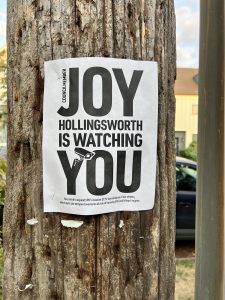
This flier was also spotted in Capitol Hill:

In other surveillance news, DivestSPD found that state and federal law enforcement officers are sharing license plate data on obscure Seattle police email lists. 

The Intercept reported on how the company Fusus connected City of Seattle officials, including Claudia Gross-Shader from the Auditor’s Office, to a man, Marshall Freeman, who they introduced as the deputy chief administrative officer of the Atlanta Police Department. What Fusus neglected to tell the City was that Freeman is a member of their board and owns a small share of the company. The City didn’t find out until recently; in the meantime, Seattle bought Fusus’s real-time crime center software for an estimated price of $1.8 million. 

The kicker? “Gross-Shader also noted that the city had not seen research demonstrating the ability of Fusus’s technology to play a significant role in reducing retail theft, the issue that originally brought her to look into the company.”

Flock Safety, known for its extensive nationwide network of license plate readers, has rolled out a new feature that analyzes driving patterns to determine “suspicious” behavior and flag people as potential participants in organized crime. The ACLU writes about several reasons why this is concerning.

Forest Park, a city in Illinois, gave U.S. Customs and Border Patrol access to their license plate data. This example is noteworthy because Forest Park doesn’t use Flock Safety license plate readers, which have been garnering a lot of press recently. Their license plate readers are provided by Motorola Solutions, showing the dangers of this technology aren’t a matter of a single problematic vendor. 

Finally, Waymo self-driving cars are now being tested in the Seattle area. I know self-driving cars are a controversial issue and there are many big fans of the technology out there, but I would be remiss not to point out the surveillance capabilities of these vehicles, with LAPD and other police departments obtaining surveillance footage from these cars and using it as evidence. You can read 404 Media’s reporting about that here.  

Seattle News:

Earlier this month, I wrote about the opening of the new post-overdose stabilization ORCA center across from the King County courthouse. DESC, the organization that runs the new center, is also pioneering a different medicine treatment protocol for opioid addiction that thus far seems to be easier for people to tolerate. 

Last week, Seattle’s long-lasting consent decree finally came to an end. Mayor Bruce Harrell also announced he expects to finish negotiating a new contract with SPOG by the end of the year, about which he is very optimistic. We’ll see what he trades away to keep the CARE responders in existence. 

Harrell announced that as of the first day of school, the City has now hired more than 40 additional mental and behavioral health professionals across Seattle Public Schools (SPS) middle and high schools, for a total of over 60 mental health staff. You can read the press release about safety measures at SPS here.

Speaking of SPS, there will be a key board meeting on Wednesday, September 17 at 4:15pm where school board members are expected to vote on a pilot bringing a police officer back into Garfield High School.

Today Harrell announced $1.7 million in awards to expand services for survivors of commercial sexual exploitation (CSE). Organizations that received awards are the Organization for Prostitution Survivors, the Seattle Indian Health Board, Real Escape from the Sex Trade (REST), and Consejo Counseling and Referral Service. Notably absent from the list is one of former Councilmember Cathy Moore’s favorite providers, The More We Love.

King County and Washington State news:

This week, the King County Council voted in favor of moving forward the process of buying and opening a crisis care center in Capitol Hill. 

Washington Supreme Court Justice Mary Yu announced her retirement at the end of the year. Governor Bob Ferguson will appoint a replacement to serve until an election next year, where candidates will run to finish Yu’s term, which goes until the end of 2028. 

Washington Supreme Court justices are required to retire the year they turn 75 years old. Associate Chief Justice Charles Johnson will be turning 75 in 2026, and Justice Barbara Madsen will be turning 75 in 2027. With three Supreme Court seats up for grabs in the next few years, these upcoming judicial elections will shape the future of Washington state. 

Recent Headlines:

The City of Seattle is watching you Read More »

SPOG President says DC is a “blueprint” of Trump’s future public safety actions across the nation

Surveillance News:

Seattle’s public safety committee passed its surveillance expansion proposal out of committee before the council’s summer recess. We are expecting a final vote on the proposal on Tuesday, September 9 at 2pm. As usual, public comment will be heard at the beginning of this meeting. 

I went onto Hacks & Wonks to discuss this surveillance expansion further, as well as how it ties into the greater federal surveillance expansion, so keep an eye out for that episode later this week. 

For now, I’ll give you a little preview. President Donald Trump announced the federal takeover of the Washington DC police department the day before the Seattle committee vote on the surveillance expansion was taken. Reporting shows that there is now most likely federal control over DC’s real time crime center. Right now that surveillance can help the feds with their immigration crackdown in DC, but that’s just the tip of the iceberg in terms of what this surveillance data can be used to accomplish, particularly for a federal government that is rapidly moving into authoritarianism. That Seattle might somehow be uniquely immune to this attempt is wishful thinking at best.

Seattle Police Officers Guild (SPOG) President Mike Solan recently had the D.C. Police Union Chairman Gregg Pemberton on his podcast to discuss the situation in DC. Pemberton said the police in DC welcome the intervention by the feds, and Solan clearly supported Trump’s actions in this regard as well. 

Solan said, “Pay attention to what’s happening in the District of Columbia because it is the blueprint of what you’re going to see nationwide when it comes to the Trump administration’s public safety actions.”

Solan is elected by a majority of SPD’s rank and file to represent them.

In Seattle, CCTV security footage (private cameras in this case, as opposed to the cameras owned by SPD) led to the incorrect arrest of an innocent man for an arson in Wallingford. He was held in jail for a month before his case was resolved. His defense attorneys called the SPD’s actions in this case a “rushed and racist misidentification.”

In other surveillance news, it turns out US Customs and Border Patrol has had direct access to Flock Safety’s license plate reader database through a “federal pilot program.” Flock says it has now paused all federal pilots. 

Over at Cascade PBS, Nate Sanford is doing a deep dive on local governments’ usage of ChatGPT. The two stories focus on Bellingham and Everett, as they responded more quickly to public record requests than other cities such as Seattle.

Seattle News:

A new pilot bringing a police officer back to Garfield High School might be beginning soon. The school board is expected to vote on the issue at their September 17 meeting. 

Mayor Bruce Harrell provided the necessary letter of support that allows the crisis care center in Capitol Hill to move forward

SPOG has donated $350 to Ann Davison’s reelection campaign for Seattle City Attorney. New reporting at PubliCola says that Davison has failed to live up to her campaign promises made when she first ran back in 2021. 

Real Change reported that SPD spent almost twice as much on legal settlements as had been budgeted between 2014 and 2024. The amount SPD has gone over budget has increased a great deal since 2020. 

DivestSPD reported that almost 400 SPD officers made more than $200,000 in 2024. 76 officers made more than $300,000. 

King County News:

King County is significantly expanding its youth mobile crisis teams from two teams up to nine. 

Candidate for King County Executive (and current Councilmember) Claudia Balducci said she’s planning to introduce a measure to use part of the county’s recently passed 0.1% public safety sales tax bump in order to create a retail crimes task force. Kroger recently decided to shut down a Fred Meyer in Kent (and also one in Lake City), a decision that some people are attributing to shoplifting. Balducci’s opponent Girmay Zahilay, along with UFCW 3000 (the grocery workers union), question whether this is really the primary reason for the store closures.

The King County council passed the county’s public safety sales tax, which is a regressive tax that hits poorer people harder, in order to deal with the county’s upcoming budget deficit. However, there might be a bit of money left over from the tax, and a big question during the county’s budget season will be how this extra money will be spent. King County’s public health programs and clinics, as well as its behavioral health services, are expected to be hard hit financially by federal policy changes. One possible use of any extra dollars could be bridging some of these new and expected funding gaps.

Recent Headlines: 

SPOG President says DC is a “blueprint” of Trump’s future public safety actions across the nation Read More »

SPD wants to stop calling its surveillance program a “pilot” 3 weeks after implementation

We have more news than usual in this edition because I took a vacation, and then it’s taken a long time to catch up from being on vacation. So let’s get to it!

Surveillance News:

First off, I have a new story out this week about the expansion of Flock license plate readers (ALPRs) in WA state…and how the data is being used to assist ICE/DHS and search for people who have received abortions. I received a tip last week about an audit of the King County Housing Authority’s Flock data that shows it’s likely been accessed for both purposes. I know this is a somewhat technical story, but in my opinion it’s also one of the bigger stories I’ve reported on. 

In important and actionable news, SPD has proposed material updates to its SIRs on CCTV cameras and its real time crime center. You might remember that these cameras and the crime center went live on May 20th of this year. SPD asked for permission to stop calling this program a “pilot” three weeks after everything went live. I don’t know about you, but when I think pilot, I don’t think three weeks of testing is sufficient. 

SPD is asking to add more CCTV cameras to the network in three NEW locations:

  1. Areas around Lumen and T-Mobile Field, including parts of the southern portions of Pioneer Square. 
  2. Areas surrounding Garfield High School between S Jackson St. to the South, E Cherry St. to the North, 20th Ave. S to the West, and MLK Jr. Way to the East.
  3. The Capitol Hill Nightlife District – E Union St. to the South, E Pine St. to the North, Broadway to the West, and 12th Ave. to the East. In addition, Neagle Pl. between E Pine and E Denny Way.

SPD is also asking to integrate SDOT’s traffic-monitoring cameras into its real time crime center, expanding its surveillance scope yet again.

Comments on the two surveillance impact reports (SIRs) for these changes are due on Monday, June 23. To comment on the addition of more CCTV cameras and making the surveillance program permanent after 21 days, click here. To comment on the addition of SDOT traffic cameras to the real time crime center, click here

In other surveillance news, the Seattle City Council approved Starchase for SPD use. Washington State Patrol has started using cell phone data to predict where people will practice unsafe driving habits, such as speeding and texting while driving, to increase patrols in those areas. Florida Highway Patrol appears to be taking advantage of Flock’s database to hunt immigrants, and law enforcement agencies in southern California have been breaking the law and sharing license plate reader data with out-of-state and federal agencies.

And when it comes to data privacy, I’d be remiss not to highlight reporting that federal Medicare and Medicaid data, including immigration status of patients, has been shared with the Department of Homeland Security. As the Seattle Times wrote, “The shared information includes protected health data from every Apple Health enrollee in Washington, state officials said, totaling about 1.7 million people. Among them are tens of thousands of immigrants, including undocumented immigrants and lawful permanent residents, who receive state-covered health services.”

Seattle News:

The big news as I was leaving on vacation at the beginning of the month was that Cathy Moore is resigning from Seattle City Council. Her last day will be July 7, and the council will be appointing a replacement to serve until the November 2026 election. Applications for the appointment will be open July 2 through July 9, with a public forum scheduled for July 21 and a final council vote scheduled for July 28. 

The tentative budget season calendar has been released, with Harrell’s budget proposal expected on Tuesday, September 23 and a final vote expected on November 21. That final vote is scheduled a little earlier than usual because the general election results are expected to be certified on November 25, meaning Councilmember Mark Solomon will be replaced by whoever wins the D2 general election. 

There are two public hearings for the budget, one on October 7 and one on November 6. The one on November 6 seems a bit tenuous, since the public will only have 48 hours (at most) to review Budget Chair Dan Strauss’s balancing package, and then councilmember amendments are due at noon the very next day. Such a tight turnaround makes it seem unlikely that anything new councilmembers hear during the second public hearing could make it into a proposed amendment unless something similar were already in the works. 

Interim Budget Director Dan Eder also presented to council, saying there is currently a $150 million budget deficit for 2026. That could well get worse, depending on the economy and actions of the federal government. Departments supported by General Fund and JumpStart dollars have been asked to suggest 8% departmental cuts for 2026, except for homelessness and public safety-related departments, which have been asked to suggest 2% cuts. Interestingly the Seattle City Attorney’s Office has been asked to suggest 8% worth of cuts, about which Council President Sara Nelson wasn’t happy. 

One topic of interest that came up was Councilmember Bob Kettle asking if the City is looking into using AI in order to improve city operations. Eder replied that the city budget office and Central Staff started working on this at the end of last year, considering using AI as a tool to compare and contrast some of the support departments as a pilot project to see how efficient the City’s staffing and budgets are for various duties that are common among peer cities. Eder couldn’t share more about a potential timeframe for this effort. 

Interim SPD Chief Shon Barnes is in the process of receiving his council confirmation. You can read his council confirmation packet and his answers to councilmember questions. There’s some interesting stuff in there! He presented before the public safety committee on June 10, making headlines when he said he expected to be jailed under the Trump administration. 

However, later that same day SPD used pepper spray on protesters at the downtown federal building when protesters were trying to prevent ICE from removing immigrants from the building. 

Against the backdrop of the $150 million 2026 Seattle budget deficit discussed above, Barnes has decided to spend $1.38 million annually to hire five new SPD high level staffers from outside the department, including a second deputy chief, another assistant chief, a chief of staff, a chief communications officer, and executive director of crime and community harm reduction. Whew! Thanks to PubliCola for their reporting on this pricey decision.

SPD will also be spending $30,000 for a department-wide training on stratified policing, about which I’ve written here

Former SPD Chief Adrian Diaz is suing the City and Mayor Harrell, alleging wrongful termination, retaliation, and wage theft, among other charges. PubliCola and KUOW also received new records about the investigation that led to Diaz’s termination, showing that involved officers feared retaliation (this was also included in the original write-up of the investigation). 

Finally, I interviewed Jeanie Chunn, who is running for the D2 city council seat. 

King County and WA State News:

I wrote a piece last week giving a rundown of the newly released 2024 data for King County’s Health through Housing initiative, which provides permanent supportive and emergency housing. 

The Washington state Supreme Court finally weighed in on caseload standards for public defenders. The new caseload limits take effect on January 1, 2026 and should be implemented as soon as possible, within 10 years. I can’t overstate what a big deal this decision is, and I hope I’ll have time to write a full piece about it sooner rather than later. 

Over at The Stranger, Marcus Harrison Green sat down with state attorney general Nick Brown in an interview that is well worth the read

Finally, Jeff Asher ponders why the US murder rate might be falling so much this year, and I want to share his conclusions: “With all of those caveats in mind, when I think about the main factors behind declining murder, a strong investment in communities from private and public sources after the shock of the pandemic stands out as a major cause. There is a wide array of types of support that I would put into the “community investment” basket, including jobs, infrastructure, and programming, but it could be summed up as “we spent a lot of money everywhere on stuff.””

Recent Headlines:


SPD wants to stop calling its surveillance program a “pilot” 3 weeks after implementation Read More »

Yes, surveillance technology IS helping ICE and allowing law enforcement to hunt abortion seekers

Seattle News:

First up, I published an article this week on the debate over bringing police officers back to Seattle Public Schools…and the related debate as to whether the forthcoming FEPP levy should help pay for it. The next school board meeting to discuss the district’s proposal around police in schools, including a potential new Memorandum of Understanding between the district and SPD, will take place on Wednesday, June 4 at 4:15pm at the John Stanford Center. There will be a rally ahead of time at 3:45pm. 

Meanwhile, the City Council’s Select Committee on the FEPP Levy met on Thursday morning and discussed many possible amendments. Several councilmembers signaled that they would like to see police back in schools. 

There has been lots of concern over what data ICE may be accessing in its quest to deport people. Recent record requests show that data collected from Flock’s license plate readers has been shared with ICE for immigration purposes. Uncovered data also shows police in Texas used Flock data to perform a nationwide search for a person who had an abortion

Many local municipalities are giving information to ICE in return for funding from the State Criminal Alien Assistance Program (SCAAP). The United States government has collected the DNA from 133,000 migrant children and stores the data in a criminal database.

Locally, Mountlake Terrace City Council is deciding next week whether they should sign onto purchasing Flock’s surveillance services as well. One can only hope someone shares the news of Flock’s data being used to assist ICE and hunt down people who received abortions with the councilmembers prior to the vote on June 5.

The Northwest Progressive Institute released a couple of widely discussed polls this week and last week. One poll showed the mayoral race, and Katie Wilson’s candidacy in particular, is more competitive than some people assumed. Another poll showed how unpopular Seattle’s elected officials currently are. 

Perhaps recognizing the especial unpopularity of the recent proposal to weaken the city council’s Code of Ethics, Councilmember Cathy Moore announced this morning that she withdrew the bill. However, she signaled that she might well revisit the issue again in the future.  

There were a few great investigative pieces this week. Real Change discovered that both SPD and the FBI used confidential informants during the George Floyd protests of 2020. The FBI was also conducting surveillance during that period. As the article says, “Technologies used by the FBI to surveil Seattle protesters could be seen as a way to circumvent Seattle’s surveillance ordinance if the output of that surveillance was fed directly to SPD.”

And in reporting at The Urbanist, it appears that the City was trying to bury an independent report on allegations raised against the OPA and OIG about obtaining and disclosing a protester’s private medical records. According to the Urbanist, the report found that Andrew Myerberg, who was the head of the OPA at the time and now works for the Mayor’s Office, “improperly disclosed the protester’s private medical information, and improperly interpreted the meaning of those medical records, despite not being trained to do so. Improper disclosure means that Myerberg violated state medical privacy laws, and therefore violated City policy.”

However, Jeremy Racca, who works as Mayor Bruce Harrell’s chief of staff and general counsel, in consultation with Pacifica Law Group, LLC, as outside counsel, formed a second opinion that actually what Myerberg did was fine.

Finally, SPD delivered its quarterly sworn staffing, overtime, and performance metrics report to city council this week. SPD is estimating it will need an additional $6.8 million to $10 million by the end of the year to pay for all the extra police officers they are hiring. 911 call response times have gone down because last year CARE and SPD had a project to re-prioritize call types, which moved a bunch of Priority 1 call types down to Priority 2. 

Recent Headlines:

Yes, surveillance technology IS helping ICE and allowing law enforcement to hunt abortion seekers Read More »