ALPR

Surveillance cameras don’t prevent violence, or why I feel like a broken record

Seattle News:

Yesterday several elected officials – Mayor Katie Wilson, Council President Joy Hollingsworth, Councilmembers Debora Juarez, Bob Kettle, Maritza Rivera, and Dan Strauss, and Seattle City Attorney Erika Evans – along with SPD Chief Shon Barnes, held a press conference about the gun violence along Aurora Ave N. 

Mostly those named above talked about solving the problem with police and prosecutions, as well as by the strategic blocking of certain streets. Kettle touted the importance of the real time crime center and license plate readers, although there is no evidence that shows these technologies prevent violence. Interestingly, Aurora Ave N is one of the zones where CCTV cameras have been installed and operational in Seattle, and yet somehow there is still gun violence happening there. Hmm. 

Kettle also spoke of the importance of hiring more police officers. 

Evans said her office has asked for funding for a dedicated Extreme Risk Protection Order (ERPO) prosecutor, which she says would help get guns off the streets. Her office is also aggressively pursuing businesses and properties that break chronic nuisance laws. 

Lastly, her office is working to have a dedicated, dually-deputized prosecutor in their office that will work on felony trafficking cases on Aurora in partnership with the King County Prosecutor’s office. I’m not really sure why having this prosecutor work in the Seattle City Attorney’s office (CAO) versus the King County Prosecuting Attorney’s office (KCPAO) makes a difference. Traditionally CAO only prosecutes misdemeanors and gross misdemeanors, while the KCPAO handles all felonies. It could be that this might improve collaboration between the offices or it might be solely an issue of money (who’s going to pay for this prosecutor’s salary). 

Evans stated unequivocally that SOAP and SODA orders do not work and that she will be pursuing other strategies. 

Not mentioned were the environmental changes made to Aurora Ave in Shoreline that seem to have helped deter violence there. Solutions such as increased social supports, a coordinated gun violence prevention strategy, and legalized sex work were also not emphasized. 

That being said (see below), Wilson is reportedly working on a gun violence prevention strategy, but unfortunately the details still haven’t been announced. 

Meanwhile, The Seattle Medium reported that Black girls represent between 44% and 52% of child sex trafficking victims in King County. 

Earlier this week, the Seattle City Council passed the one-year data center moratorium and related resolution, after which Washington AI resistance (WA-AIR) held a press conference announcing a new campaign for their People’s AI Bill of Rights, which will be a package of bills regulating AI introduced during the 2027 state legislative session. The campaign will begin with a state-wide listening tour. 

Wilson announced that the City would be turning on the CCTV cameras located in the Stadium District due to “general but credible threats to security during the games” provided to her during briefings with SPD and the FBI. Two days before the announcement, she publicly defined a credible threat in more narrow terms, that being the standard she had originally announced she was planning to use to inform her decision as to whether to turn on the cameras. To read more about it, check out the op-ed by Phil Mocek published by PubliCola.

The Seattle Auditor’s Office released a status report on implementation of their recommendations covering the time period through December 2025. Of note:

  • Re their 2024 Annual Surveillance Technology Usage Review (released in September 2025), SDOT has implemented two out of eight recommendations.
  • Re their Four Recommendations to Better Understand and Address Current Gun Violence Patterns in Seattle (released in March 2025), all four recommendations remain pending: “The Mayor’s Office reported that they have begun development of a comprehensive gun violence reduction strategy that will build on work begun by the Human Services Department and be led by the Mayor. Specifically, the Mayor’s Office has begun to assess existing gun violence reduction programs, identify gaps, and build a comprehensive strategy sponsored by the Mayor.”
  • Re their Addressing Places in Seattle Where Overdoses and Crime are Concentrated: An Evidence-Based Approach (released in July 2024), two out of eight recommendations have been completed: “The Mayor’s Office reported that components of the Downtown Activation Team’s (DAT) work, including its place-based problem-solving methodology, are moving forward under the Stabilize, Activate, and Invest (SAIL) Subcabinet. The Mayor’s Office indicated they will tailor crime and overdose strategies, and the corresponding deployment of resources, to more specifically defined and localized problems, beginning with implementation of the Phố Đẹp safety plan in Little Saigon and the expansion of the Seattle Police Department’s Neighborhood Resource Officer program to 12th & Jackson and 3rd & Pine. The Mayor’s Office also indicated that the current administration does not intend to evaluate the preceding administration’s work of the DAT and Seattle Restoration Framework, but will instead collaborate with public health, public safety, and community partners to establish agreed upon metrics for success for each location and reporting expectations.”

A quick update on an earlier item regarding the possibility of a special fire district tax: PubliCola has reported that the firefighters’ union is opposed to the idea so the Mayor’s Office isn’t pursuing it this year. This means one fewer tool to address the $175 million deficit for 2027.

In SPD lawsuit news, two gay SPD officers are suing the department alleging discrimination and being passed over for promotion. The City of Seattle is paying a $2.6 million settlement in the lawsuit of four female SPD officers alleging sexual harassment from former Chief Adrian Diaz. The Seattle Times reports that three of the four women remain employed at SPD. 

For more uplifting news, I wrote about the soil-turning and future plans for a new health center in Rainier Beach. If you want to read about community members coming together to make a difference, this is the article for you. 

Other news: 

I wrote about an inmate who died of an overdose last year while in custody at SCORE jail. I really encourage you to check this one out because the ongoing issues at SCORE are for the most part not being covered by mainstream media like The Seattle Times or the local news networks. I dove deeper into the quality of healthcare being offered by jails and prisons in general, and it’s an ugly story that has parallels to how people detained by ICE are being treated. 

I also dove into last year’s King County DCHS audit with an update on what’s been found and what measures are being taken to ensure accountability and transparency as DCHS goes about their work. 

King County Executive Girmay Zahilay gave his State of the County address this week and committed to investing “nearly $5 million” in the Regional Office of Gun Violence Prevention. I’m not clear on how much of this is additive, but as an important office that is perennially under-funded, this is good news. 

The City of Edmonds unanimously voted to cancel the City’s contract with Flock Safety for automated license plate readers.

Finally, Jeff Asher wrote that large police departments are beginning to grow their ranks again, after a contraction after the Covid-19 pandemic began in 2020. 

Asher wrote, “The hiring environment still isn’t great for police officers, but it is far improved from where it was three or four years ago. Most medium and large police departments will likely be stuck at considerably smaller levels than they were pre-COVID, but the evidence suggests they might see slow and steady growth over the next few years.”

Recent Headlines:

Surveillance cameras don’t prevent violence, or why I feel like a broken record Read More »

State millionaires income tax: a big swing among budget cuts

Seattle News:

Last week I chatted with Hannah Sabio-Howell, who is challenging Washington State Senator Jamie Pedersen for his seat in the 43rd LD. I expect this to shape up to be an interesting race!

I also recently covered the current backlog over at the Seattle City Attorney’s Office, and how City Attorney Erika Evans is planning to adjust workflow to try to deal with it. Evans also said the office needs more money, which could be difficult given Mayor Katie Wilson recently asked all city departments to prepare a list of potential cuts for this year’s budget season. 

And I reported on SPD’s committee report in response to a budget SLI passed last November on their federal immigration enforcement policies. I used quotes liberally in this article because it was one of those meetings where I felt it was important for people to know what had been said. 

I’ll have an article out very soon about the detention facilities moratoriums in Seattle, King County, and elsewhere, as well as some more news out of the Northwest ICE Processing Center in Tacoma. 

SPD has claimed that its real time crime center has tripled “the odds that a victim receives justice.” PubliCola wrote about what this means, pointing out that SPD is defining “receiving justice” as arrests made (with no details about prosecution, jail time, or how the RTCC was involved), which can also result in overpolicing.

Almost a month ago, CARE Chief Amy Barden attended a Public Safety committee meeting to reiterate what she’s been saying all along: that the new SPOG contract approved in December is preventing Seattle’s CARE team from doing their jobs. I was on vacation at the time, but Erica Barnett wrote a great article on the topic, which also links to her live reporting on Bluesky. 

Memorably, Barden was chided by Councilmember Martiza Rivera for being honest about the impacts of the new SPOG contract on the CARE team. 

“I agree there’s plenty of work to go around, and we need to work together,” Rivera said. “And so what I would like to see is working together, less accusatory language, and how can you be, you know, a person of change, to really work together to make things happen. So rather than constantly pointing out maybe the negative and what is not going well, let’s hear about what is going well and how you can help make things better.”

From her words, it sounds like Rivera doesn’t want to hear about the negative consequences of her vote on the SPOG contract, nor does she appear to want to grapple with the reality that the police are blocking the effective deployment of alternative response in Seattle.

WA State News:

The big news has been the passage of the millionaires’ income tax after over 24 hours of debate in the House. It even looks like Governor Bob Ferguson might agree to sign it! In return, lawmakers have rolled back last year’s increase on the estate tax, bringing down the top rate from 35% to 20%.

Included in the millionaires tax is a rollback of a sales tax on services passed last year, set to take effect in 2029. Because cities and counties collect sales tax (not just the state), this repeal will have an effect on local municipalities’ bottom lines, as well as Sound Transit’s finances.

The legislature also passed the state’s operating budget. There is already an $878 million budget hole expected for 2027, which will have to be dealt with next session. Legislators used the rainy day fund and a few discontinued tax breaks to try to close this year’s budget gap, which was worsened by the state having to pay large amounts on lawsuit payouts for government misconduct. The budget includes cuts to child care, Transition to Kindergarten, and local effort assistance money for public school students.  

The ALPR bill also made it through concurrence and is on its way for the governor’s signature. I’ll be writing in detail about what’s actually in the final bill and what it means for surveillance in the state.

On Flock license plate readers specifically: Flock updated its terms and conditions on February 16, 2026, making several changes. Of particular note, Flock now has a perpetual license to use Customer Data (meaning even after a specific contract ends or is canceled) and Flock is now allowed to use all Customer Data for its own product development. The terms for privacy commitments around training data have been removed from the new contract, including the commitment to never sell or share the training data with third parties. 

Other changes have been made, including making the agreement governed by the laws of the State of Georgia, after mandatory mediation and arbitration. You can read about all the changes here.

Recent Headlines:

State millionaires income tax: a big swing among budget cuts Read More »

Two weeks after UW report, WA’s driver data is still accessible for immigration enforcement

WA State News:

I’ve written two big stories about surveillance, personal data, and the state over the past two weeks. 

One of them covers a recent University of Washington (UW) Center of Human Rights report that found that the Washington State Department of Licensing is almost certainly still sharing personal driver data with ICE. 

Yesterday, I received an update from the UW Center of Human Rights saying they’ve been able to identify an additional six cases in which ICE or the U.S. Customs and Border Patrol (CBP) queried data from the Washington State Department of Licensing (DOL) prior to conducting immigration arrests. At least two of these six cases are confirmed to have been civil immigration arrests. The center expects to continue discovering more such cases in the future. 

In addition, the center confirmed that the state has not taken any action to cut off CBP from accessing Washington state’s driver information from the DOL, even though the majority of relevant queries are performed by CBP. ICE Homeland Security Investigations (HSI) also retains the ability to query the DOL’s data. 

It has been two weeks since the UW Center of Human Rights’ report was released showing the DOL’s data is still being used for civil immigration enforcement in the state of Washington. 

Angelina Godoy, founding director of the UW Center for Human Rights, was the guest on an episode of the podcast In the Meanwhile, released today. During the podcast, Godoy said, “We need to demand more of our state governments to hold them accountable to promises that they have already made. I think many state governments, and I believe Washington is one of them, are scrambling to figure out ways to keep folks safe, but this is a way they can do that. It’s a vulnerability they have known about, and it’s a decision on their part not to have taken action to date. So that’s why this is alarming.” 

My other story covers an automated license plate reader (ALPR) bill currently working its way through the legislature. It just had its first hearing on Tuesday. It’s important to note that while regulating the use of these cameras is an improvement over the complete lack of regulation that is the current status quo, privacy advocates told me it would be much safer if ALPRs were banned altogether. 

During an executive session of this bill on Thursday, a substitute bill was approved that raises the retention time of the ALPR data from 72 hours (which advocates already said was too long) to 21 days. Negotiations are ongoing, and some local privacy groups have set up an action to take.

Unsurprisingly, some people are unhappy with all the cuts proposed in Governor Bob Ferguson’s 2026 supplemental budget. Rep. Shaun Scott’s bill to impose a payroll expense tax similar to the JumpStart tax across the state received a hearing on Thursday, but we already know Ferguson is “not a big fan.” 

In other tax news, the legislature is revisiting the idea of a tax on short-term rentals like Airbnb and Vrbo, to be used by local municipalities for affordable housing and rental assistance. In favor are the aforementioned cities and counties; opposed are Airbnb operators. 

Rep. Julia Reed’s bill, HB 2098, would close a tax loophole for big tech companies and use the money to provide a fully funded higher education for Washington families earning 100% of median family income or below. It had a hearing on Wednesday, and both the University of Washington and Washington State University Pullman testified against the bill in spite of the cuts to higher education in Ferguson’s budget proposal. 

Reed noted on social media that both of those universities receive donations from Amazon and Microsoft, who are current beneficiaries of the tax loophole. 

Fewer people are buying Obamacare coverage for 2026 due to the failure of Congress to renew the enhanced federal subsidies that made such coverage more affordable. In Washington State, 277,255 people enrolled for Obamacare in 2026, compared to 291,493 in 2025–a difference of 14,238. I’ll take this opportunity to remind us all that studies show that expanding Medicaid eligibility decreases violence. Assumedly, kicking people off their insurance (or making it unaffordable) could have the opposite effect. 

PubliCola reported on a few bills that would help codify the rights of unhoused people in the state. HB 2266 would prohibit shelter and temporary housing bans and make it easier to site these housing resources, while HB 2489 would prohibit cities from passing bans on sleeping and other survival activities unless they can show they have enough available “adequate” shelter, which means shelter that wouldn’t involuntarily separate a person from their partner or their pet, for example.

PubliCola also reported on HB 1125, which would allow people to apply for resentencing. (Washington State doesn’t have parole, making this bill especially salient.) 

Seattle News:

During her first week in office, my Urbanist editor Doug Trumm and I were able to go to City Hall to interview new Seattle Mayor Katie Wilson. 

Last week I also sat down and spoke to Nilu Jenks, who is running for the Seattle City Council District 5 seat this November. 

Carolyn Bick recently published some top-notch investigative reporting in The Stranger. They uncovered a recent report from Madison’s  Office of the Independent Monitor documenting a failed body-worn camera pilot program stewarded by Chief Shon Barnes at his old police department in Madison. Critically, the report found that “Barnes had ignored City Council’s “multiple directives” for essential, specific guardrails, which likely violated state law.” 

The report specifically said the failure was Barnes’. 

This information is especially important given Barnes is overseeing the rapid expansion of SPD’s surveillance program. Seattleites may wonder: if Barnes felt comfortable disregarding many of the Madison City Council’s directives about the body worn camera pilot in 2024, will he feel similarly empowered to run Seattle’s surveillance “pilot” as he sees fit today? 

Given the current federal risks towards immigrants, the LGBTQ+ community, and people of color, the stakes around surveillance are very real and very high. 

Last week, SPD’s policy office sent an unsigned directive to instruct officers on how to respond to calls about ICE. PubliCola sums up this policy succinctly: “If you see someone being grabbed off the street or attacked by ICE in Seattle, feel free to call the local police—just don’t expect them to do anything about it.”

PubliCola also reported on SPD hiring in 2025, finding that 90% of its officer hires were men.

Meanwhile, the Department of Homeland Security (DHS) and ICE are looking into expanding their detention capacity in the local area. According to a 187-page draft contract dated December 2025, “The objective of this contract is to obtain comprehensive detention, transportation, and food services for ICE detainees located in the Seattle, WA area in support of the ICE ERO Seattle Field Office.”

Body camera footage from the protest at last year’s Memorial Day far-right Mayday USA event was released that shows SPD officers’ intent to respond violently to protesters. SPD Officer Matthew Didier can be heard saying, “We’re here to fuck people up now,” and “We’re going in this time with guns blazing and all our pieces in place.”

This was only a few months after the Seattle City Council passed a new ordinance giving SPD greater leeway to use less lethal weapons at protests. This legislation paved the way for Seattle’s exit from an extremely lengthy consent decree that was prolonged due to SPD’s violent behavior during the George Floyd protests of 2020. 

The Seattle LGBTQ Council sent a letter last week saying that nearly all investigations relating to misconduct at the 2025 Memorial Day protest have been completed. Out of 28 allegations against 13 officers, only two have been sustained against a single officer, who received a written reprimand. 

Finally, the board of the Seattle Social Housing Developer fired its CEO, Roberto Jimenez, last week. Tiffani McCoy of House Our Neighbors has stepped up to serve as its interim CEO. 

Recent Headlines:

Related to ICE:

Everything else:

Two weeks after UW report, WA’s driver data is still accessible for immigration enforcement Read More »

SPOG gets a great new contract while legal settlements related to SPD greatly increase

Seattle News:

First off, I spoke (well, emailed) with Mayor-elect Katie Wilson about her vision for public safety and homelessness. Wilson has said publicly, and I think rightfully so, that for her first term, she expects to be judged on public safety and homelessness, so I tried to pull back the curtain on her thinking about those topics as she prepares to tackle a difficult job.

Relatedly, Wilson announced yesterday that she intends to keep SPD Chief Shon Barnes in his position…at least for now. My guess is that she’ll be watching to see how he performs under the new administration. In the meantime, the Capitol Hill Blog did an excellent rundown of several of Barnes’s mistakes over his first several months as SPD Chief.

Seattle City Council passed the new SPOG contract on Tuesday in a 6-3 vote, with Councilmembers Alexis Mercedes Rinck, Eddie Lin, and Rob Saka voting against. Unlike the last couple of SPOG contracts, I didn’t expect this vote to be unanimous, but I was surprised by Saka’s decision.

As I’ve covered before, this new SPOG contract does not notably improve police accountability in Seattle, and it also continues to prevent the CARE team, who provides civilian alternative response in Seattle, from doing their jobs. Not a fine day for Seattle. 

This week the public safety committee heard a year-end report on SPD. This year, SPD has hired 159 new officers and had 65 separations, resulting in a net increase of 94 officers. As we’ve been discussed previously, crime is down across the board, not just here in Seattle but across the country. In Seattle, this includes a decrease in homicides and shots fired. 

SPD has announced a 2025 year-to-date homicide clearance rate of 83%, which they contrast with 57% in 2024 and 49% in 2023. Because homicides were down in 2025, there were 37 victims, which was 21 or 36% fewer than the previous year. In the same time period of 2024, there were 58 victims.

Let’s do a little math, shall we? 

57% cases cleared with 58 victims = 33.06 cases cleared

83% cases cleared with 37 victims = 30.71 cases cleared

Please note the above isn’t accurate because some cases have more than one victim. But it does serve to illustrate why we should take clearance rate percentage changes with a grain of salt unless we see all the data. And we should also consider where that data comes from.  

Publicola reported on SPD’s parking enforcement officers (PEOs), whose labor contract with the City is in mediation and who are currently staging a “work slowdown.” Long-time readers will remember that the PEOs were moved from SPD to SDOT in 2020 in one of the only ways in which SPD was “defunded.” While the defunding of that move might not have been particularly meaningful, given the money was simply moved from one department to another for the same purpose, the switch in attitudes of PEOs might have been a true improvement. However, PEOs were moved back to SPD in 2023 in a win for SPD, which tends to want to retain as many functions (and as large a budget) as possible. PubliCola reminded me that the move back was intended to improve hiring and retention, which surprise, surprise, hasn’t panned out. 

PubliCola also reported that SPD has far overrun its overtime budget this year, another circumstance that should come as no surprise to long-time readers. 

The Office of the Inspector General (OIG) released a report in August on claims and lawsuits involving SPD, covering a period from 2019-2023. A few key takeaways:

  • Between 2014 and 2023, 172 lawsuits were filed involving SPD. Police action (61%) and police negligence involving the fleet (19%) were the most common. According to the report, fleet claims are “for incidents involving SPD vehicles, such as minor vehicle collisions or allegations of SPD drivers failing to operate a vehicle with due care for the safety of the public.”
  • Between 2021 and 2023, the City paid about $13 million in settlements involving SPD. In contrast, between 2014 and 2020, the City paid about $6 million in settlements involving SPD. 

Surveillance news:

Mountlake Terrace canceled their contract with Flock Safety for license plate readers, and Olympia suspended their Flock contract. 

Spokane has been using their Flock license plate readers to surveil protesters, which you might recall was another group of folks civil rights organizations and concerned citizens pointed out would be targeted and harmed by increased surveillance. The Electronic Frontier Foundation (EFF) has found many agencies across the country have been using similar surveillance on protesters.  

A Wisconsin sheriff’s department is using incredibly vague search terms while searching the Flock license plate reader database, a move that is likely to continue to spread as law enforcement agencies attempt to evade transparency around how they’re using these surveillance tools. 

The ACLU is pushing a new bill in the state legislature this year that would regulate the use of license plate readers in the state. I’ll be writing more about this bill, probably in January. 

A clarification: I’ve seen an increase lately in folks referring to “Flock cameras” to mean any kind of surveillance camera. Seattle, for example, does not have a contract for any Flock cameras, although it does have license plate readers and CCTV cameras. So when in doubt about what kind of camera, it’s always okay to simply say “surveillance camera” instead of specifying the brand name. 

King County and Washington State news:

The King County office of the ombuds has taken over the investigation of grants given by King County’s Department of Community and Human Services (DCHS) to several community organizations for four different youth programs. The investigation began after an audit earlier this year.

Crisis Connections, the crisis care center in Kirkland, remains underutilized a year after opening. Their involuntary commitment unit is often full (which isn’t a required part of a King County crisis care center), but the center has served close to 4,000 unique patients in a bit over a year, while King County estimated each center should be able to serve 14,000 unique patients per year. 

Connections recently received the grant to run the crisis care center in Capitol Hill, and The Seattle Times reports they were one of three providers who applied to do so. 

At the state level, lawmakers are gearing up for next year’s legislative session in Olympia. In addition to the license plate reader bill referenced above, lawmakers are bringing forward a bill to ban face coverings for law enforcement officers. The federal government is suing California over a similar law, and if the federal government should succeed in their suit, the Washington law in question would only apply to state and local law enforcement, rendering it much less useful. 

As Washington State faces a budget deficit, Governor Bob Ferguson has said his upcoming budget proposal will balance that deficit with cuts instead of new revenue. But that declaration hasn’t stopped other lawmakers from making their own progressive revenue proposals:

  • Rep. Shaun Scott (D-43, Seattle) has proposed progressive revenue similar to Seattle’s JumpStart payroll tax, which is estimated to bring in over $2 billion per year. Scott wants to spend the funds on education, health care, and human service programs (planning for upcoming federal cuts in spending). 
  • Scott is also proposing to end a tax break for big banks in order to invest in the state’s wildfire mitigation fund, which was cut 50% earlier this year.
  • Rep. Julia Reed (D-36, Seattle) has proposed removing a tax rate cap on big tech companies in order to fund more higher education investments. 
  • Democrat lawmakers are interested in making changes to a new retail sales tax to reduce its impact on school districts. Republicans want to repeal the tax altogether. 
  • I’m hearing more and more rumblings about a state income tax. Here is the latest rumbling, in which House Majority Leader Joe Fitzgibbon is quoted as saying an income tax isn’t something lawmakers should “shy away” from. 

Recent Headlines:

SPOG gets a great new contract while legal settlements related to SPD greatly increase Read More »

It’s been a hard month for license plate readers in Washington State

Seattle News:

Katie Wilson will be Seattle’s next mayor, and Seattle’s 2026 budget has been adopted! Whew, what a month. 

I wrote my take on the budget last week, a few days before its final passage. You can also read a list of budget amendments proposed by the councilmembers and PubliCola’s budget wrap-up. 

No budget discussion would be complete without noting both the efforts on the parts of councilmembers to limit the Mayor-elect’s budget flexibility. There are also deep concerns over the likely loss of federal funding for housing and homelessness programs via the Continuum of Care funds from HUD, especially permanent supportive housing funding. 

A coalition of states, including Washington, has filed a lawsuit against HUD over the above policy changes.

King County has selected Connections Health Solutions to run the new crisis care center in Capitol Hill. Connections already runs the crisis care center in Kirkland and is a national company as opposed to a local community based provider. 

DivestSPD published some charts last week about changes at the Office of Police Accountability (OPA). According to Divest, the OPA only fully investigated 23% of complaints in 2025 compared to 37% in 2023, when the department was under the leadership of former Director Gino Betts. 

OPA contact logs have also increased from 16% in 2022 to 28% in 2025, so it will be interesting to hear from the OPA next year (now under the leadership of Bonnie Glenn) as to why this is the case. 

For those interested in the Families, Education, Preschool, and Promise (FEPP) levy spending plan, the Department of Education and Early Learning (DEEL) is holding four community outreach/conversation sessions in December, for which you can RSVP:

  • Tuesday, December 2, 5:30–7:30 PM at the Magnuson Community Center, 7110 62nd Ave NE, Seattle, WA 98115 
  • Wednesday, December 10, 5:30–7:30 PM at the Ballard Branch – Seattle Public Library, 5614 22nd Ave NW, Seattle, WA 98107 
  • Thursday, December 11, 5:30–7:30 PM at Denny International Middle School, 2601 SW Kenyon St, Seattle, WA 98106 
  • Tuesday, December 16, 5:30–7:30 PM at Rainier Community Center, 4600 38th Ave. S, Seattle, WA 98118 

Divest SPD reported that less than 10% of 2025 SPD recruits were women, a blow to the department’s 30×30 initiative. 

Skeptics of the initiative point out that women making up 30% of the police force wouldn’t necessarily fix the systemic issue of police violence. Also concerning is the department’s efforts to recruit women without a clear plan in place to address what appears, from both lawsuits and conditions documented in a 30×30 report published in September 2023, to be a hostile workplace for women. 

New Councilmember Eddie Lin was sworn in today. Councilmember-elect Dionne Foster and Mayor-elect Katie Wilson won’t be sworn in until the beginning of 2026, but because Lin’s seat was being held by an appointee, he was sworn in early. 

For the same reason, King County Executive Girmay Zahilay was sworn in today. 

Surveillance News:

I wrote about Washington cities’ struggle with what to do about Flock Safety license plate readers (ALPRs), both because of the evidence that the data is being shared with federal agencies, including ICE, and because of a recent lawsuit brought by the cities of Stanwood and Sedro-Wooley in which ALPR video was deemed to be within valid public record parameters. As a result, many Washington cities have paused or delayed their ALPR programs. 

In the summer, I reported that it looked like the King County Housing Authority’s (KCHA) ALPR camera data had been shared with federal agencies such as ICE. KCHA has since decided to end their ALPR pilot. 

Since I wrote the article, Stanwood and Sedro-Wooley have appealed the court decision about whether ALPR video counts as a public record, and residents of Olympia are asking their city council to shut down their Flock ALPR program.

There are also new records showing that ALPR programs are being used to surveil protesters and activists, including in Washington state. 

Meanwhile,The Intercept found that fusion centers were being used to surveil pro-Palestine protests on at least five college campuses across the country. Fusion centers were established after 9/11 to better enable information sharing between federal, state, and local law enforcement agencies, including campus police. 

“The normalization of intelligence sharing between campus police departments and federal law enforcement agencies is widespread across U.S. universities,” the Intercept wrote.

Washington State News:

Governor Bob Ferguson made an appointment to fill the upcoming vacancy on the Washington Supreme Court: Colleen Melody, who spent the last decade working at the Attorney General’s office leading the civil rights division (a position to which she was hired by Ferguson). While at the AG’s office, Melody was deeply involved in filing lawsuits against President Donald Trump’s executive orders during his first term from 2017-2020. A career government lawyer, Melody has never before served as a judge. 

Melody will serve as a Supreme Court justice for 2026, but she would have to run for election next November in order to retain the judgeship. The big question to consider, should she choose to run, is her stance on the legality of a wealth tax in Washington state. 

The latest state revenue forecast showed a slight uptick in revenue projections for the current biennial budget (2025-2027), but not enough to make much difference. Talk abounds about potential new revenue sources for the state. It’s unclear if we’ll see a repeat to this year’s legislative session when Ferguson said he’d veto any budget proposal that included a wealth tax. 

Ferguson is expected to release his budget proposal before the end of the year, giving us a few weeks to review it before the next state legislative session begins on January 12. 

Recent Headlines:

It’s been a hard month for license plate readers in Washington State Read More »

City Council begins budget gymnastics as alternative response in Seattle takes another blow from the new SPOG contract

My Recent Stories:

First up, we have my Urbanist story documenting the saga of King County’s pre-filing youth diversion program Restorative Community Pathways, which King County Executive Shannon Braddock is planning to replace with a new program. I’ve been following this story for some months and was just waiting for the Impact Justice evaluation to be released before writing it up. However, it turned out to be so complex that I think this is the longest story to date I’ve published at The Urbanist. I haven’t seen this covered in this depth at any other outlet thus far, and I hope you’ll take the time to have a read. 

Last week the new SPOG contract was announced, and I combed through it so you don’t have to. Several aspects of this new contract surprised me, but perhaps most of all, I was surprised it wasn’t more favorable for the City, given the timing of its release only two weeks before the mayoral election. The continued hindrance of the SPOG contract on the CARE alternative response team’s ability to do their jobs is particularly noteworthy. 

Finally, I wrote about the recent King County Department of Public Defense report on Seattle’s 2023 drug criminalization ordinance and the folks being brought into the criminal legal system as a direct result of it. I also provide an update on the SODA order numbers. 

Seattle News:

In Seattle, much of the news is either budget or election related. 

The fall revenue forecast came out, and it was better than anticipated (certainly better than I thought it would be!) However, given all the recent tech layoffs and federal government worker furloughs, as well as the potential for the AI investment bubble to burst and continued uncertainty around tariffs, I do wonder if the adopted forecast might end up being a little rosier than what we’ll actually see in 2026. But I certainly hope to be wrong! 

That being said, the Seattle City Council has very little money to play with in terms of allocating spending to their own priorities in the 2026 budget, and we see this tension very starkly in all the new spending proposed by councilmembers’ proposed amendments this week. Councilmembers are suggesting spending many millions more than are available, which will mean either most of these amendments will be jettisoned or other cuts in the budget will have to be made. 

We’ll have to wait and see which amendments make it into Budget Chair Dan Strauss’s balancing package when he releases it next Wednesday. You can view the full agendas for previous budget meetings, including lists of the proposed amendments, here, here, and here. You can also find the agenda for the October 17 meeting, which included Central Staff issue considerations for SPD, SFD, CARE, and HSD.

Councilmembers are proposing budget additions of almost $3 million to SPD and $21.7 million to HSD, as well as several million to the fire department to expand Health One, among other priorities. Councilmember Bob Kettle has proposed moving LEAD, Co-LEAD, and We Deliver Care contracts from HSD directly to the CARE department, which involves a financial transfer between the two city departments. 

Councilmembers have also requested some reporting, including three reports I’d really like to see: one that would require SPD to report on federal immigration enforcement policies (co-sponsored by every councilmember except Council President Sara Nelson); one that would require SPD ​​to provide quarterly reports on staffing, overtime, and performance metrics; and one that would require IT to provide a series of reports on the City’s investments in and uses of AI. 

Also noteworthy, as reporting from PubliCola discussed, is a whopping 30% increase in the Office of Economic Development’s (OED) budget proposed by Mayor Bruce Harrell. An interesting facet of this is that the director of OED has donated to Harrell’s reelection campaign and sent an email soliciting city workers’ personal email addresses, which he gave to Harrell’s campaign manager. 

In other news, King County’s “Health Through Housing’s” Sharyn Grayson House, a 35-unit supportive housing unit in Capitol Hill run by the Lavender Rights Project with support from Chief Seattle Club, is ready to receive residents. 

Worth reading is an opinion piece in Real Change by Marigold Green, who is both a sex worker and a sex trafficking survivor who breaks down the City of Seattle’s recently announced awards for funding for sex trafficking prevention, which Green says has anti-sex-work implications. 

Surveillance News:

Last week, the University of Washington’s Center for Human Rights published a report about Flock Safety’s surveillance privacy gaps in Washington State, including license plate reader data shared with U.S. Border Patrol/ICE. Local cities found to be sharing data with Border Patrol included Auburn and Renton. The report’s release triggered several Washington police departments to “change” their surveillance programs, per The Seattle Times. 

On a personal note, one of my surveillance articles for The Urbanist was mentioned in the report, and I’m glad to see awareness of these surveillance issues continue to grow, as is evinced by Rachel Maddow speaking about federal surveillance via cell phone for several minutes on MSNBC on Monday. 

Recent Headlines:

City Council begins budget gymnastics as alternative response in Seattle takes another blow from the new SPOG contract Read More »

Is there a budget bloodbath in the offing?

Personal News:

I’ve been a bit quieter than usual lately because my beloved little dog Nala died last week. I took several days off to spend some quality time with her beforehand, and I’ve been slowly gearing back up. I miss her terribly, of course, and am also very grateful that she lived such a good, long life (she was nearly 18!) and that everyone is being so kind to me as I adjust to this huge change.

Amy in a coat, hat, and scarf holding a cute little dog in a red jacket, the sandy beach and sunset behind them

Seattle and King County News:

I wrote about the Seattle Public Schools school board vote last week on a year-long pilot to bring a police officer back to Garfield High School. Things didn’t go the way I thought they would, as the board rejected the pilot proposal.

I wrote about Mayor Bruce Harrell’s proposal to use part of the new public safety sales tax money (which Council just passed in an 8-1 vote, Councilmember Maritza Rivera the sole nay vote) to double the number of CARE alternative responders. The CARE alternate response teams have been struggling since their inception due to an overly restrictive MOU with SPOG. I also wrote about a “mysterious” and sudden drop in police referrals to the CARE team, which coincidentally happened right after SPOG members had trouble with their paychecks due to the City using faulty new payroll software. Hmm. 

The Seattle Times published a similar story with this great lede: “Leadership with Seattle’s new police alternative has become increasingly frustrated with what they view as “a pattern of subversion” by street-level officers who seem to be routinely rejecting or ignoring assistance from civilian responders, records show.”

Relatedly, the Office of the Inspector General (OIG) just released a report on the CARE team.

And I wrote about the new SPOG contract that Harrell has said he is almost done negotiating. Will it drop before or after the election? I’m fascinated to find out. 

SPD and Chief Shon Barnes have been engaging in some questionable promotions, as PubliCola has reported: Marc Garth Green, who was demoted after making offensive comments about sex workers, was promoted to commander of the West Precinct, and Mike Tietjen, who has several worrisome disciplinary actions on his record, including allegedly harassing a trans woman, was promoted to be in charge of the East Precinct. Barnes later walked back Tietjen’s new assignment, seemingly due to PubliCola’s coverage, blaming “internal leaks” and “a lack of comprehensive input from those involved in employee assignments.”

The King County Council approved the plans for the new crisis care center in Capitol Hill at the old Polyclinic building. 

I have been industriously listening to both Seattle and King County budget meetings. King County has successfully bridged their deficit for the 2026-2027 biennium with the new public safety sales tax, although they’ll be struggling to deal with federal impacts on services. Seattle will be receiving its revenue forecast on Monday, which might lead to a bit of a bloodbath for the budget depending on how bad the forecast turns out to be.

Surveillance news:

The Seattle Metro Chamber recently conducted a poll with this statement: “Recently passed laws, such as installing closed circuit cameras to capture real -time information about crime on our streets and keeping people out of areas where they have previously committed crimes are making Seattle safer and reducing crime.”

51% of respondents agreed (with only 17% strongly agreeing), while 46% of respondents disagreed. 

In local journalism circles, SPD is known as a place where you send public record requests to die. However, recent reporting from Hardpressed reveals that SPD is fulfilling public record requests for ICE in less than four days. The article further states:
“The initial six pages of records provided by Mayor Harrell’s office show that ICE is requesting information on people the SPD has charged with lowly crimes such as drug possession and fourth degree (gross misdemeanor) assault, which can be charged with no injury and for something as simple as a push. It is unclear based on the limited information and redactions made by Harrell’s office within the released records if the individuals SPD arrested were ever convicted of a crime.” 

404 Media has followed up on their reporting about Flock Safety and their ALPR database. Flock’s database was searched by law enforcement in Texas looking for a woman who had self-administered an abortion. It turns out that said law enforcement had considered charging the woman they were searching for with a crime.

Meanwhile, 404 Media discovered that ICE, the Secret Service, and the Navy’s criminal investigation unit all had access to Flock’s huge data network. This news prompted US Senator Ron Wyden of Oregon to write a letter to Flock, in which he said, “I now believe that abuses of your product are not only likely but inevitable, and that Flock is unable and uninterested in preventing them. Cities around the country, including in Oregon, are currently reevaluating their decision to install Flock cameras. I commend and support this reexamination. In my view, local elected officials can best protect their constituents from the inevitable abuses of Flock cameras by removing Flock from their communities.”

The City of Mountlake Terrace, which voted to purchase Flock automated license plate recognition (ALPRs) back in June, has been continuing to discuss the issue. Councilmember William Paige, Jr. originally voted in favor of the technology, but he has changed his mind and now wants to cancel the contract. It’s possible the most recent news, along with the letter from Wyden, might sway more councilmembers.

The Flock cameras haven’t yet been installed in Mountlake Terrace. 

A few more recent articles about surveillance you might be interested in checking out:

Recent Headlines:

Is there a budget bloodbath in the offing? Read More »

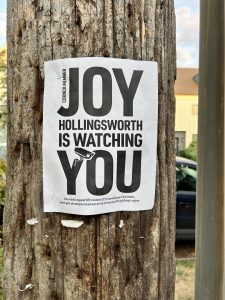
The City of Seattle is watching you

Surveillance News:

First off, I’ll share my piece on Seattle’s surveillance expansion. City Council passed the legislation to implement this expansion on a 7-2 vote on Tuesday. Yesterday I heard about a website that some concerned citizens put up with a good round-up of media coverage of the vote.

Lavender Rights Project, Seattle Pride, and the Seattle DSA have made social media posts against the expansion. Lavender Rights Project wrote, “Lavender Rights Project is located directly within the zone of this projected surveillance expansion. Yet no impact analysis was conducted, nor was robust effort made to engage with our staff, or the communities we represent–those who will be most affected by these decisions. This disregard highlights exactly whose safety is prioritized, and whose lives are put at risk.”

This flier was also spotted in Capitol Hill:

In other surveillance news, DivestSPD found that state and federal law enforcement officers are sharing license plate data on obscure Seattle police email lists. 

The Intercept reported on how the company Fusus connected City of Seattle officials, including Claudia Gross-Shader from the Auditor’s Office, to a man, Marshall Freeman, who they introduced as the deputy chief administrative officer of the Atlanta Police Department. What Fusus neglected to tell the City was that Freeman is a member of their board and owns a small share of the company. The City didn’t find out until recently; in the meantime, Seattle bought Fusus’s real-time crime center software for an estimated price of $1.8 million. 

The kicker? “Gross-Shader also noted that the city had not seen research demonstrating the ability of Fusus’s technology to play a significant role in reducing retail theft, the issue that originally brought her to look into the company.”

Flock Safety, known for its extensive nationwide network of license plate readers, has rolled out a new feature that analyzes driving patterns to determine “suspicious” behavior and flag people as potential participants in organized crime. The ACLU writes about several reasons why this is concerning.

Forest Park, a city in Illinois, gave U.S. Customs and Border Patrol access to their license plate data. This example is noteworthy because Forest Park doesn’t use Flock Safety license plate readers, which have been garnering a lot of press recently. Their license plate readers are provided by Motorola Solutions, showing the dangers of this technology aren’t a matter of a single problematic vendor. 

Finally, Waymo self-driving cars are now being tested in the Seattle area. I know self-driving cars are a controversial issue and there are many big fans of the technology out there, but I would be remiss not to point out the surveillance capabilities of these vehicles, with LAPD and other police departments obtaining surveillance footage from these cars and using it as evidence. You can read 404 Media’s reporting about that here.  

Seattle News:

Earlier this month, I wrote about the opening of the new post-overdose stabilization ORCA center across from the King County courthouse. DESC, the organization that runs the new center, is also pioneering a different medicine treatment protocol for opioid addiction that thus far seems to be easier for people to tolerate. 

Last week, Seattle’s long-lasting consent decree finally came to an end. Mayor Bruce Harrell also announced he expects to finish negotiating a new contract with SPOG by the end of the year, about which he is very optimistic. We’ll see what he trades away to keep the CARE responders in existence. 

Harrell announced that as of the first day of school, the City has now hired more than 40 additional mental and behavioral health professionals across Seattle Public Schools (SPS) middle and high schools, for a total of over 60 mental health staff. You can read the press release about safety measures at SPS here.

Speaking of SPS, there will be a key board meeting on Wednesday, September 17 at 4:15pm where school board members are expected to vote on a pilot bringing a police officer back into Garfield High School.

Today Harrell announced $1.7 million in awards to expand services for survivors of commercial sexual exploitation (CSE). Organizations that received awards are the Organization for Prostitution Survivors, the Seattle Indian Health Board, Real Escape from the Sex Trade (REST), and Consejo Counseling and Referral Service. Notably absent from the list is one of former Councilmember Cathy Moore’s favorite providers, The More We Love.

King County and Washington State news:

This week, the King County Council voted in favor of moving forward the process of buying and opening a crisis care center in Capitol Hill. 

Washington Supreme Court Justice Mary Yu announced her retirement at the end of the year. Governor Bob Ferguson will appoint a replacement to serve until an election next year, where candidates will run to finish Yu’s term, which goes until the end of 2028. 

Washington Supreme Court justices are required to retire the year they turn 75 years old. Associate Chief Justice Charles Johnson will be turning 75 in 2026, and Justice Barbara Madsen will be turning 75 in 2027. With three Supreme Court seats up for grabs in the next few years, these upcoming judicial elections will shape the future of Washington state. 

Recent Headlines:

The City of Seattle is watching you Read More »

SPOG President says DC is a “blueprint” of Trump’s future public safety actions across the nation

Surveillance News:

Seattle’s public safety committee passed its surveillance expansion proposal out of committee before the council’s summer recess. We are expecting a final vote on the proposal on Tuesday, September 9 at 2pm. As usual, public comment will be heard at the beginning of this meeting. 

I went onto Hacks & Wonks to discuss this surveillance expansion further, as well as how it ties into the greater federal surveillance expansion, so keep an eye out for that episode later this week. 

For now, I’ll give you a little preview. President Donald Trump announced the federal takeover of the Washington DC police department the day before the Seattle committee vote on the surveillance expansion was taken. Reporting shows that there is now most likely federal control over DC’s real time crime center. Right now that surveillance can help the feds with their immigration crackdown in DC, but that’s just the tip of the iceberg in terms of what this surveillance data can be used to accomplish, particularly for a federal government that is rapidly moving into authoritarianism. That Seattle might somehow be uniquely immune to this attempt is wishful thinking at best.

Seattle Police Officers Guild (SPOG) President Mike Solan recently had the D.C. Police Union Chairman Gregg Pemberton on his podcast to discuss the situation in DC. Pemberton said the police in DC welcome the intervention by the feds, and Solan clearly supported Trump’s actions in this regard as well. 

Solan said, “Pay attention to what’s happening in the District of Columbia because it is the blueprint of what you’re going to see nationwide when it comes to the Trump administration’s public safety actions.”

Solan is elected by a majority of SPD’s rank and file to represent them.

In Seattle, CCTV security footage (private cameras in this case, as opposed to the cameras owned by SPD) led to the incorrect arrest of an innocent man for an arson in Wallingford. He was held in jail for a month before his case was resolved. His defense attorneys called the SPD’s actions in this case a “rushed and racist misidentification.”

In other surveillance news, it turns out US Customs and Border Patrol has had direct access to Flock Safety’s license plate reader database through a “federal pilot program.” Flock says it has now paused all federal pilots. 

Over at Cascade PBS, Nate Sanford is doing a deep dive on local governments’ usage of ChatGPT. The two stories focus on Bellingham and Everett, as they responded more quickly to public record requests than other cities such as Seattle.

Seattle News:

A new pilot bringing a police officer back to Garfield High School might be beginning soon. The school board is expected to vote on the issue at their September 17 meeting. 

Mayor Bruce Harrell provided the necessary letter of support that allows the crisis care center in Capitol Hill to move forward. 

SPOG has donated $350 to Ann Davison’s reelection campaign for Seattle City Attorney. New reporting at PubliCola says that Davison has failed to live up to her campaign promises made when she first ran back in 2021. 

Real Change reported that SPD spent almost twice as much on legal settlements as had been budgeted between 2014 and 2024. The amount SPD has gone over budget has increased a great deal since 2020. 

DivestSPD reported that almost 400 SPD officers made more than $200,000 in 2024. 76 officers made more than $300,000. 

King County News:

King County is significantly expanding its youth mobile crisis teams from two teams up to nine. 

Candidate for King County Executive (and current Councilmember) Claudia Balducci said she’s planning to introduce a measure to use part of the county’s recently passed 0.1% public safety sales tax bump in order to create a retail crimes task force. Kroger recently decided to shut down a Fred Meyer in Kent (and also one in Lake City), a decision that some people are attributing to shoplifting. Balducci’s opponent Girmay Zahilay, along with UFCW 3000 (the grocery workers union), question whether this is really the primary reason for the store closures.

The King County council passed the county’s public safety sales tax, which is a regressive tax that hits poorer people harder, in order to deal with the county’s upcoming budget deficit. However, there might be a bit of money left over from the tax, and a big question during the county’s budget season will be how this extra money will be spent. King County’s public health programs and clinics, as well as its behavioral health services, are expected to be hard hit financially by federal policy changes. One possible use of any extra dollars could be bridging some of these new and expected funding gaps.

Recent Headlines: 

SPOG President says DC is a “blueprint” of Trump’s future public safety actions across the nation Read More »

SPD wants to stop calling its surveillance program a “pilot” 3 weeks after implementation

We have more news than usual in this edition because I took a vacation, and then it’s taken a long time to catch up from being on vacation. So let’s get to it!

Surveillance News:

First off, I have a new story out this week about the expansion of Flock license plate readers (ALPRs) in WA state…and how the data is being used to assist ICE/DHS and search for people who have received abortions. I received a tip last week about an audit of the King County Housing Authority’s Flock data that shows it’s likely been accessed for both purposes. I know this is a somewhat technical story, but in my opinion it’s also one of the bigger stories I’ve reported on. 

In important and actionable news, SPD has proposed material updates to its SIRs on CCTV cameras and its real time crime center. You might remember that these cameras and the crime center went live on May 20th of this year. SPD asked for permission to stop calling this program a “pilot” three weeks after everything went live. I don’t know about you, but when I think pilot, I don’t think three weeks of testing is sufficient. 

SPD is asking to add more CCTV cameras to the network in three NEW locations:

  1. Areas around Lumen and T-Mobile Field, including parts of the southern portions of Pioneer Square. 
  2. Areas surrounding Garfield High School between S Jackson St. to the South, E Cherry St. to the North, 20th Ave. S to the West, and MLK Jr. Way to the East.
  3. The Capitol Hill Nightlife District – E Union St. to the South, E Pine St. to the North, Broadway to the West, and 12th Ave. to the East. In addition, Neagle Pl. between E Pine and E Denny Way.

SPD is also asking to integrate SDOT’s traffic-monitoring cameras into its real time crime center, expanding its surveillance scope yet again.

Comments on the two surveillance impact reports (SIRs) for these changes are due on Monday, June 23. To comment on the addition of more CCTV cameras and making the surveillance program permanent after 21 days, click here. To comment on the addition of SDOT traffic cameras to the real time crime center, click here. 

In other surveillance news, the Seattle City Council approved Starchase for SPD use. Washington State Patrol has started using cell phone data to predict where people will practice unsafe driving habits, such as speeding and texting while driving, to increase patrols in those areas. Florida Highway Patrol appears to be taking advantage of Flock’s database to hunt immigrants, and law enforcement agencies in southern California have been breaking the law and sharing license plate reader data with out-of-state and federal agencies.

And when it comes to data privacy, I’d be remiss not to highlight reporting that federal Medicare and Medicaid data, including immigration status of patients, has been shared with the Department of Homeland Security. As the Seattle Times wrote, “The shared information includes protected health data from every Apple Health enrollee in Washington, state officials said, totaling about 1.7 million people. Among them are tens of thousands of immigrants, including undocumented immigrants and lawful permanent residents, who receive state-covered health services.”

Seattle News:

The big news as I was leaving on vacation at the beginning of the month was that Cathy Moore is resigning from Seattle City Council. Her last day will be July 7, and the council will be appointing a replacement to serve until the November 2026 election. Applications for the appointment will be open July 2 through July 9, with a public forum scheduled for July 21 and a final council vote scheduled for July 28. 

The tentative budget season calendar has been released, with Harrell’s budget proposal expected on Tuesday, September 23 and a final vote expected on November 21. That final vote is scheduled a little earlier than usual because the general election results are expected to be certified on November 25, meaning Councilmember Mark Solomon will be replaced by whoever wins the D2 general election. 

There are two public hearings for the budget, one on October 7 and one on November 6. The one on November 6 seems a bit tenuous, since the public will only have 48 hours (at most) to review Budget Chair Dan Strauss’s balancing package, and then councilmember amendments are due at noon the very next day. Such a tight turnaround makes it seem unlikely that anything new councilmembers hear during the second public hearing could make it into a proposed amendment unless something similar were already in the works. 

Interim Budget Director Dan Eder also presented to council, saying there is currently a $150 million budget deficit for 2026. That could well get worse, depending on the economy and actions of the federal government. Departments supported by General Fund and JumpStart dollars have been asked to suggest 8% departmental cuts for 2026, except for homelessness and public safety-related departments, which have been asked to suggest 2% cuts. Interestingly the Seattle City Attorney’s Office has been asked to suggest 8% worth of cuts, about which Council President Sara Nelson wasn’t happy. 

One topic of interest that came up was Councilmember Bob Kettle asking if the City is looking into using AI in order to improve city operations. Eder replied that the city budget office and Central Staff started working on this at the end of last year, considering using AI as a tool to compare and contrast some of the support departments as a pilot project to see how efficient the City’s staffing and budgets are for various duties that are common among peer cities. Eder couldn’t share more about a potential timeframe for this effort. 

Interim SPD Chief Shon Barnes is in the process of receiving his council confirmation. You can read his council confirmation packet and his answers to councilmember questions. There’s some interesting stuff in there! He presented before the public safety committee on June 10, making headlines when he said he expected to be jailed under the Trump administration. 

However, later that same day SPD used pepper spray on protesters at the downtown federal building when protesters were trying to prevent ICE from removing immigrants from the building. 

Against the backdrop of the $150 million 2026 Seattle budget deficit discussed above, Barnes has decided to spend $1.38 million annually to hire five new SPD high level staffers from outside the department, including a second deputy chief, another assistant chief, a chief of staff, a chief communications officer, and executive director of crime and community harm reduction. Whew! Thanks to PubliCola for their reporting on this pricey decision.

SPD will also be spending $30,000 for a department-wide training on stratified policing, about which I’ve written here. 

Former SPD Chief Adrian Diaz is suing the City and Mayor Harrell, alleging wrongful termination, retaliation, and wage theft, among other charges. PubliCola and KUOW also received new records about the investigation that led to Diaz’s termination, showing that involved officers feared retaliation (this was also included in the original write-up of the investigation). 

Finally, I interviewed Jeanie Chunn, who is running for the D2 city council seat. 

King County and WA State News:

I wrote a piece last week giving a rundown of the newly released 2024 data for King County’s Health through Housing initiative, which provides permanent supportive and emergency housing. 

The Washington state Supreme Court finally weighed in on caseload standards for public defenders. The new caseload limits take effect on January 1, 2026 and should be implemented as soon as possible, within 10 years. I can’t overstate what a big deal this decision is, and I hope I’ll have time to write a full piece about it sooner rather than later. 

Over at The Stranger, Marcus Harrison Green sat down with state attorney general Nick Brown in an interview that is well worth the read. 

Finally, Jeff Asher ponders why the US murder rate might be falling so much this year, and I want to share his conclusions: “With all of those caveats in mind, when I think about the main factors behind declining murder, a strong investment in communities from private and public sources after the shock of the pandemic stands out as a major cause. There is a wide array of types of support that I would put into the “community investment” basket, including jobs, infrastructure, and programming, but it could be summed up as “we spent a lot of money everywhere on stuff.””

Recent Headlines:


SPD wants to stop calling its surveillance program a “pilot” 3 weeks after implementation Read More »